Insights
Generating new memories
Using models and agents to access new insights
By
Doug Cook
—
26
May
2025
In the rapidly evolving landscape of AI, Retrieval-Augmented Generation (RAG) represents a compelling step forward. Already we’re helping a number of our partners incorporate this technology.
RAG combines the reasoning power of large language models with the ability to access external sources of truth, effectively introducing a form of memory that expands what machines can understand and recall in real time.
While large language models have unlocked remarkable creative and analytical possibilities, most still operate in isolation. Trained on static data, they generally respond to prompts without memory or evolving context. This limits their usefulness, particularly in applications where adaptability and situational awareness are important.
Pre-trained models and “agentic” interfaces
Most RAG systems start with pre-trained models, trained on vast amounts of public data. These provide a powerful foundation, but the real magic happens when they’re combined with company-specific information.
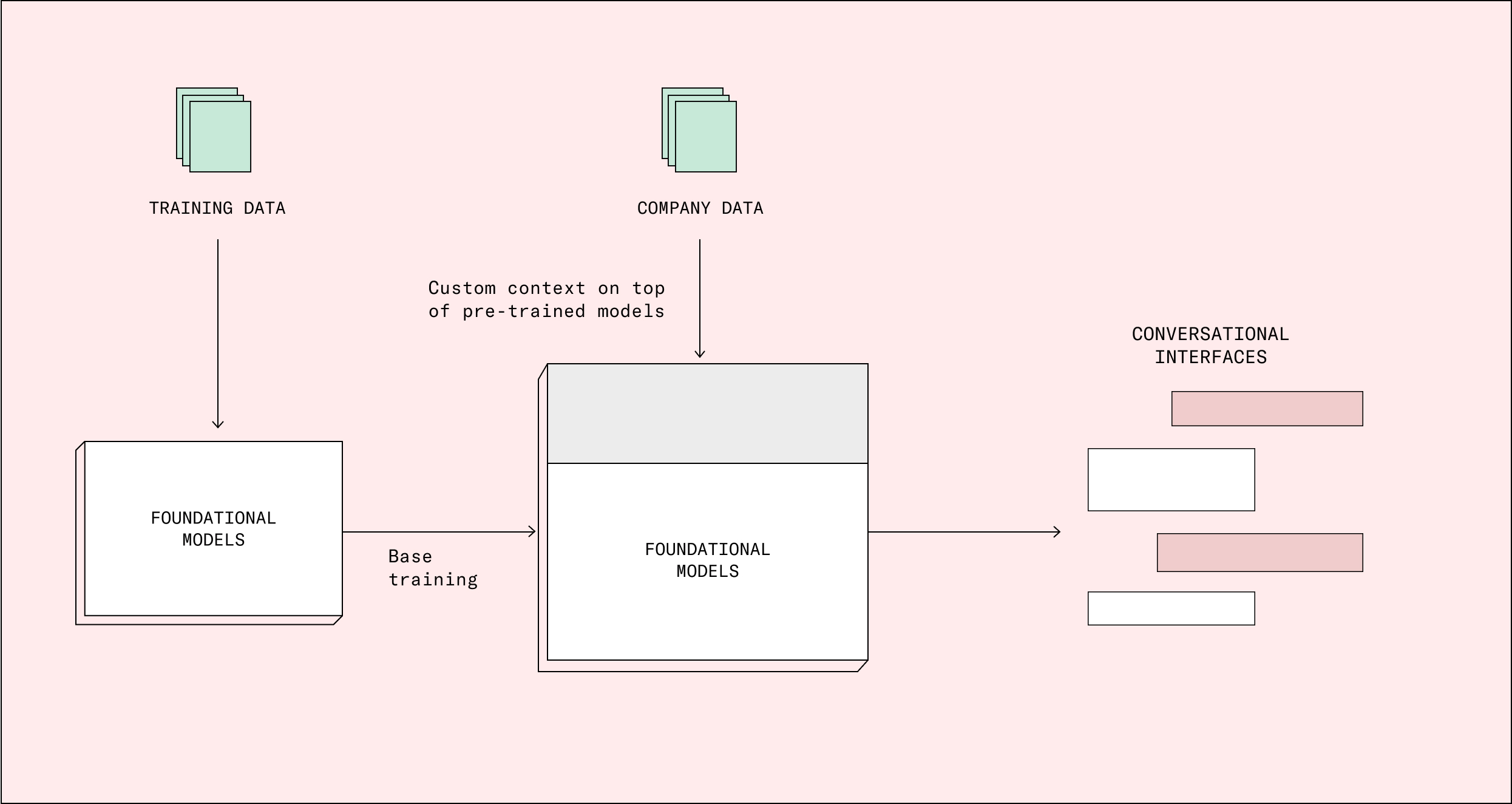
To test this approach, we designed a conversational agent named "Tater" in our Slack workspace. Tater uses a foundational model combined with a vector database populated with embeddings drawn from company resources, including our studio’s handbook, team documents, ebooks, creative resources, and project case studies.
This information allows Tater to respond with company-specific context, making it a far more valuable tool for our team. It can quickly surface relevant insights from internal documents, reflect on past projects, and support our creative process. We'll soon share more about how RAG is informing our approach to design and brainstorming.
What makes this approach especially powerful is the creation of an "inference flow,” a process where retrieval and generation happen simultaneously, without retraining the model. This allows us to combine the broad knowledge of a pre-trained model with the specialized expertise embedded in our company’s data, resulting in a conversational agent that isn’t just smart, but deeply aligned with our team’s language, culture, and needs.
Reinforcement learning using human feedback
While custom vector stores provide a solid foundation, the true potential of these systems emerges with fine-tuning. This is where hybrid models and reinforcement learning from human feedback (RLHF) come into play.
As people interact with a model through various interfaces, their feedback and interactions become valuable data points. This behavioral data can feed back into the system, allowing it to learn and adapt over time.
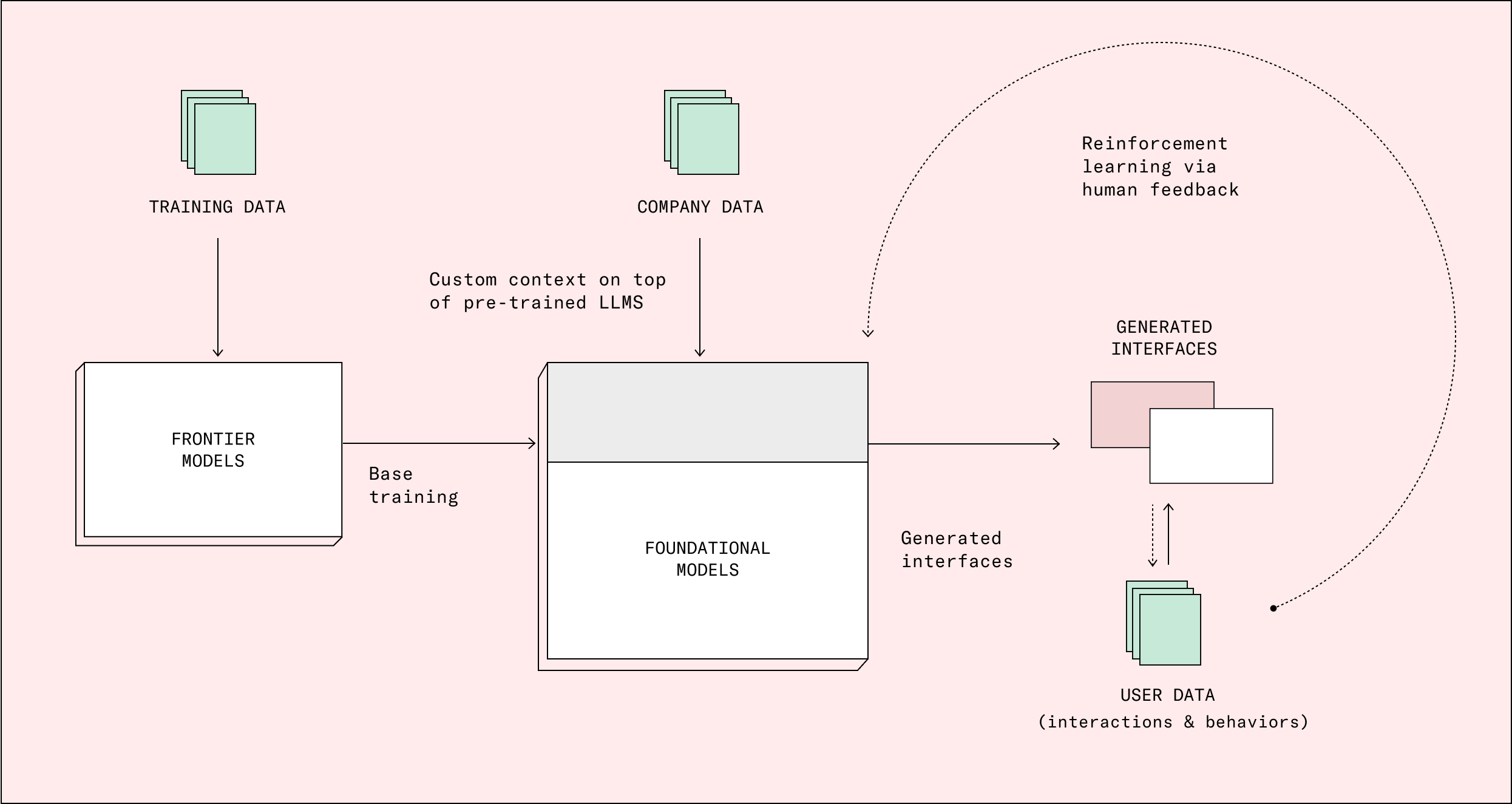
The feedback process works as follows:
- People interact with the model through both conversational and generated interfaces.
- These interactions, along with any direct feedback, are captured as user data.
- This data is used to enrich context or fine-tune the model, improving relevance and accuracy.
- The cycle repeats, creating a system that continuously learns and adapts.
This approach ensures the system continues to evolve with the organization. It becomes more attuned to user preferences, learns from its mistakes, and steadily improves its ability to deliver precise, context-aware responses. In essence, the system doesn’t just answer questions; it grows with you.
Designing intelligent systems
RAG-based systems and fine-tuned models, especially when combined with company-specific data and continuous learning, represent a meaningful leap toward AI that truly understands and supports its users. As these systems mature, we’re not just designing tools; we’re creating intelligent collaborators that adapt, assist, and evolve with the people who use them.
At thirteen23, we’re actively designing for these emerging experiences. For more perspective, check out “How LLMs are reshaping digital experiences” from our designer Jaden Flores, and explore our recent work on agents and digital co-workers helping keep people in the loop across IT and security concerns.
Doug Cook
Doug is the founder of thirteen23. When he’s not providing strategic creative leadership on our engagements, he can be found practicing the time-honored art of getting out of the way.